Inside Learn AI: how a 10-minute lesson works
Read, practice, quiz. A walk through one lesson, from the first card to the streak, and why we built it that way.

Most courses about AI are a series of videos. You watch, you nod, and a week later you write the same vague prompts you wrote before. When we designed Learn AI, we started from the opposite end: what would it take for a lesson to actually change how you use AI the next day?
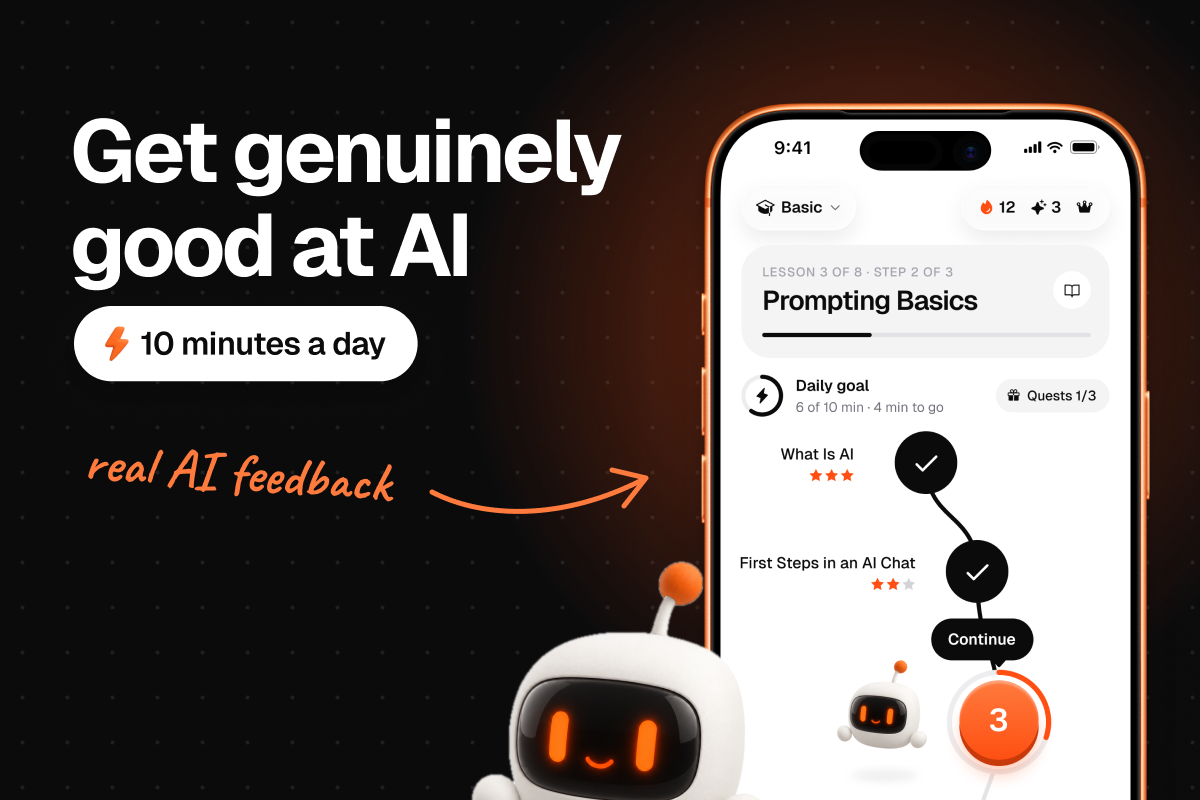
Our answer is a loop of three steps — read, practice, quiz — that fits into about ten minutes. Here's what that looks like, using lesson 3 of the Basic course, Prompting Basics.
1. Read: one idea, a few cards
The lesson opens with a handful of short cards. Each one makes a single point in plain language, with an everyday example. For Prompting Basics, the core idea is that the AI only knows what you tell it. Ask it to "write an email about our app" and it has to guess who the email is for, what the app does and how long it should be — so it fills the gaps with generic words.
There's no wall of text and no jargon you need to look up. When a term does come up, it's in the glossary one tap away.
2. Practice: do it, then get feedback
This is where the time goes, on purpose. A lesson mixes several kinds of exercises:
- What's wrong with this prompt? You see a weak prompt and the bland answer it produced, and pick the real problem.
- Matching and ordering — connect prompt parts to what they do, put the steps of a task in order.
- Chat simulator — continue a conversation with an AI and steer it toward a better result.
- Prompt Lab — write your own prompt for a real task.
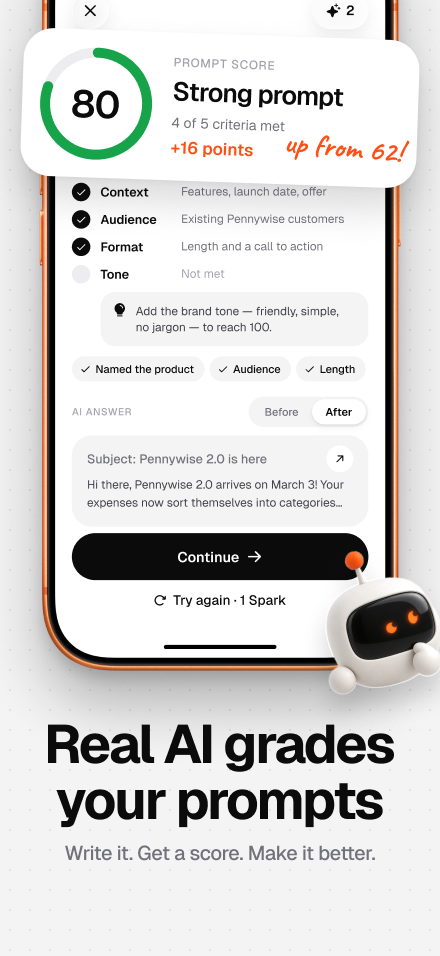
Prompt Lab is the heart of the app. Your prompt goes to a real AI model, which checks it against a short list — task, context, audience, format, tone — and returns a score out of 100 with specific suggestions: "add the brand voice", "say how long it should be". You can rewrite and try again, and you see the result improve.
That feedback loop is the thing a video can't give you, and it's why we call it practice rather than content.
3. Quiz: lock it in
A mini-quiz of a few questions closes the lesson. Anything you get wrong goes to the mistake bank in the Review tab, and the key ideas become flashcards that come back on a spaced schedule — right before you'd forget them.
Then: the streak
Finish the lesson and your daily goal fills up, your streak grows by one, and the next lesson unlocks on the path. It's a small thing, but it's what turns "I should learn this" into ten minutes every day. A streak freeze covers you on the days life gets in the way.
Why ten minutes?
Because it's short enough to start without thinking about it, and long enough to practice one skill properly. Short daily sessions with spaced review are a well-established way to make learning stick, and they fit around a job, a family or a semester.
Eight lessons like this make up the Basic course. After that, the goal tracks apply the same loop to work, studying, personal life and business — and the Advanced course swaps cards for simulators.
Want to see it for yourself? The first three lessons are free.