GPT, Claude, Gemini or Grok? Why switching models mid-chat helps
There is no single best AI model. How to pick one for the task at hand, and how to use a second opinion when an answer matters.
"Which AI is the best?" is one of the most common questions people ask about AI — and the honest answer is that it depends on the task, and it changes every few months. New versions of GPT, Claude, Gemini and Grok come out constantly, and each release shuffles the rankings.
So instead of a leaderboard that will be out of date by next season, here's a way of choosing that keeps working.
Think in tiers, not brands
Every major AI company offers models in roughly two tiers:
- Fast models — quick and cheap to run. Great for everyday questions, rewording, short summaries, simple facts and brainstorming.
- Top models — slower, but stronger at reasoning. Better for multi-step problems, maths, code, long documents, careful writing and anything where a subtle mistake would cost you.
For most people, the tier matters more than the brand. A top model from any of the leading companies will usually beat a fast model from any of them on a hard question.
Match the model to the moment
| You want to… | Start with |
|---|---|
| Ask a quick question, reword a sentence, get ideas | A fast model |
| Solve a multi-step problem or check your reasoning | A top model |
| Write something that matters — a cover letter, a client email | A top model, then compare with a second one |
| Analyze a long PDF or report | A top model |
| Brainstorm lots of options | Try two different models — they suggest different things |
Personality is real, and it's personal
Beyond raw ability, models have different styles. Some are more concise, some more thorough; some sound warmer, some more neutral; some push back more. People genuinely prefer different ones for writing, and there's no right answer. The only way to find yours is to try the same prompt on a few and see which you like.
The real trick: a second opinion
Here's where switching models earns its keep. When an answer matters, ask a second model the same question:
- If they agree, you can be more confident — though not certain, since models can share the same mistake.
- If they disagree, you've just found the exact spot to check. That's far more useful than a single confident answer.
You can also ask the second model to review the first: "Here's an answer from another AI. What's wrong or missing?" Models are often better at critiquing an answer than at getting everything right the first time.
Switching mid-chat
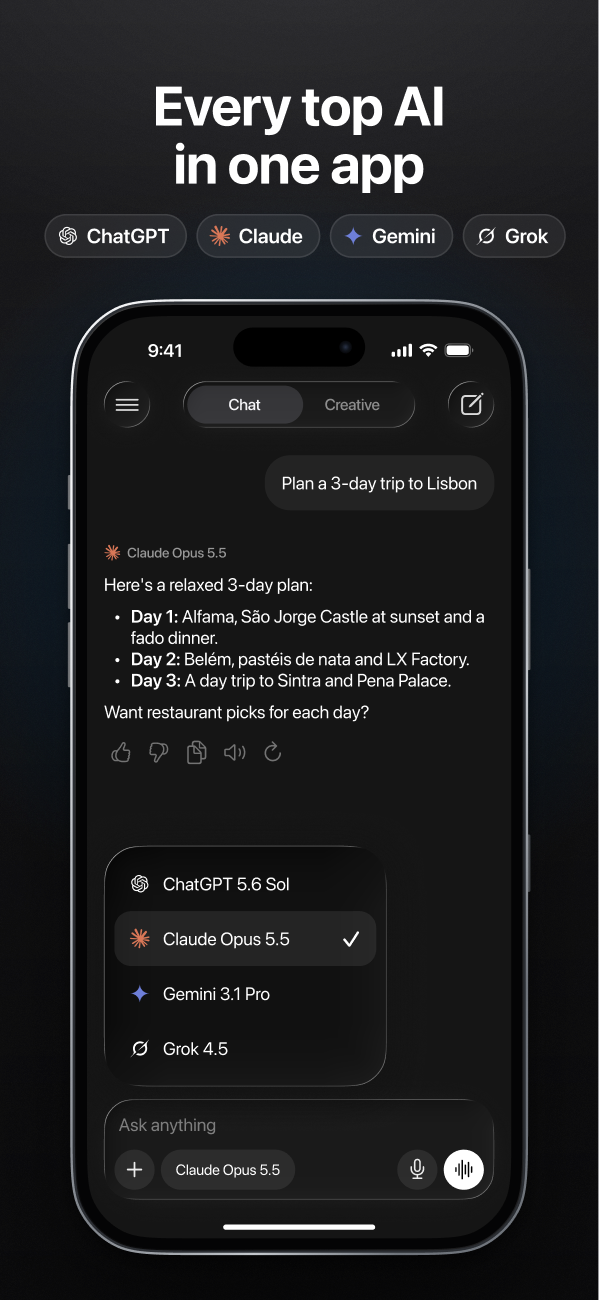
The annoying part of using several AI apps is losing your context: you have to paste the whole conversation into another app to get a second opinion. In AI Chat you switch the model inside the same chat — start with a fast model, move to a top model when the question gets hard, or regenerate any single answer with a different model and compare side by side.